

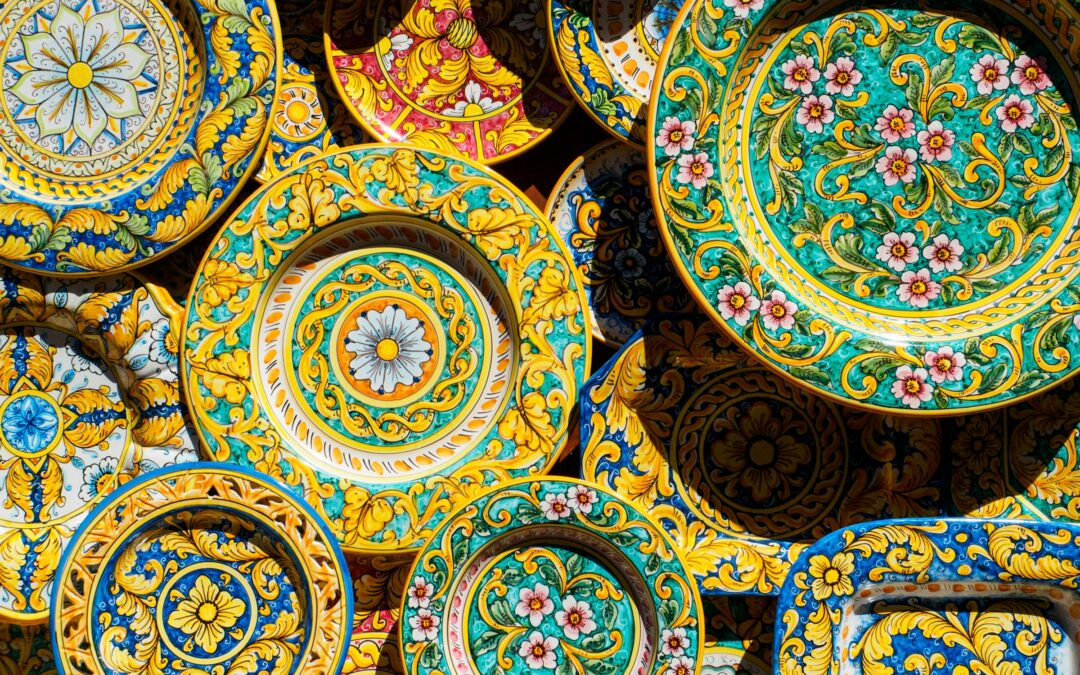
Sicily produces some of the most distinctive ceramics in the world. The tradition is ancient, the craft is still very much alive, and the results are extraordinary from hand-painted majolica tiles to sculptural pieces that carry centuries of Arab, Norman and Spanish influence in every brushstroke.
Sicilian ceramics are not a souvenir industry. They form a living craft tradition. Artisans practise it in the same towns, using the same techniques, across generations. Moreover, understanding where these pieces come from, what to look for and where to buy makes all the difference between bringing home something genuinely beautiful and leaving with a factory reproduction.
This guide covers the two great ceramic centres of the island (Caltagirone and Santo Stefano di Camastra) alongside the smaller workshops scattered across the interior, and everything you need to know before you spend your money.
Why is Sicilian ceramic art so distinctive?
Sicilian majolica is unlike any other European pottery tradition. The reason lies entirely in the island’s layered history. Over the centuries, Greeks, Romans, Arabs, Normans, Spanish and Bourbons each took their turn ruling Sicily. Each civilisation left its mark on the decorative vocabulary of local craftsmen. The result is a visual fusion that exists nowhere else on earth: geometric Arabic patterns overlaid with Spanish baroque flourishes, Norman heraldic symbols adapted into floral borders, and a colour palette dominated by the vivid yellows, blues and greens of the Mediterranean landscape.
Beyond history, however, the clay itself matters enormously. Sicily’s interior produces a particular kind of terracotta that responds well to high-temperature firing and holds glaze with exceptional consistency. Consequently, Sicilian ceramics achieve a density and richness of colour that mass-produced alternatives simply cannot match.
For those combining a ceramics visit with a broader exploration of the island, our guide to what to eat in Sicily shows how Sicilian material culture (its food, its art, its craft) forms one coherent whole.
Caltagirone: the UNESCO capital of Sicilian ceramics
Did you know? In 2002, Caltagirone earned a place on the UNESCO World Heritage List as one of the eight late baroque towns of the Val di Noto. So when you walk its streets, you are literally strolling through a World Heritage Site. Not bad for an afternoon out. Caltagirone is the undisputed centre of Sicilian ceramic production. A hilltop baroque town in the province of Catania, it has been producing decorated pottery for over two thousand years. That is longer than most countries have existed.
The town’s most famous landmark is the Scalinata di Santa Maria del Monte a monumental staircase of 142 steps, each riser faced with a hand-painted ceramic tile. Crucially, no two tiles are identical. The designs span the full range of Sicilian decorative history, from Arab geometric motifs to baroque cartouches. Climbing it slowly, pausing at each step, is one of the most visually intense experiences in all of Sicily.
What makes Caltagirone worth a full day:
- The Museo della Ceramica in the Villa Comunale gardens: the most comprehensive collection of Sicilian ceramics on the island, from pre-Greek Sicanian pieces to contemporary work;
- The Via Roma and Via Vittorio Emanuele: lined with workshops and showrooms where artisans work in full view of the street;
- The Scalinata illumination in mid-August: when thousands of candles light the entire staircase during the feast of San Giacomo, creating one of the most extraordinary spectacles in Sicily.
What to buy in Caltagirone
The town produces an impressive range of pieces. Large decorative panels, architectural tiles, tableware, figurines and the iconic pupi (puppets) and Mori (the turbaned head vases that are the symbol of Sicilian ceramics) are all available. Prices, however, vary considerably. Tourist-facing shops on the main staircase charge significantly more than the working workshops tucked into the side streets. Indeed, the latter almost always offer better value and higher quality.
Furthermore, for those arriving in Caltagirone as part of a broader south-east Sicily itinerary, our guide to the Valley of the Temples in Agrigento covers Sicily’s greatest ancient site reachable in under two hours from Caltagirone and a natural complement to any ceramics-focused visit.
Santo Stefano di Camastra: pottery on the Tyrrhenian coast
Santo Stefano di Camastra is the northern counterpart to Caltagirone. Situated on the Tyrrhenian coast between Palermo and Messina, this small town has built its entire economy around ceramic production since the seventeenth century.
The approach by road is one of the most visually striking in Sicily. For several kilometres on either side, the provincial road carries open-air showrooms stacked high with pottery: enormous amphoras, decorative plates, garden ornaments, tiles and architectural pieces in every size. In short, it looks like a permanent outdoor exhibition and in many ways, it is.
What makes Santo Stefano di Camastra different from Caltagirone
The two traditions are related, yet clearly distinct. Caltagirone is more restrained, shaped strongly by Arab and Spanish decoration. Santo Stefano, by contrast, tends towards bolder colours, simpler geometric patterns and a more rustic aesthetic that reflects its coastal, working-class origins.
Importantly, Santo Stefano is also more affordable. The same quality of piece that commands a high price in a Caltagirone showroom often appears here at considerably lower cost particularly for larger decorative items.
What to look for in Santo Stefano
- Architectural ceramics: tiles, panels and decorative inserts for kitchens and bathrooms, produced here in extraordinary variety;
- Garden pieces: amphoras, urns and planters in the traditional blue and white palette of the northern Sicilian coast;
- The Museo della Ceramica: in the town centre, a small but excellent collection documenting the local tradition from its origins to the present.
For those travelling along the northern coast, our guide to Cefalù Sicily covers the beautiful medieval town thirty minutes west of Santo Stefano. Combining a ceramics stop with a beach town and a Norman cathedral makes for one of the most rewarding single days in northern Sicily.
The Mori di Caltagirone: what is the story behind the head vases?
No discussion of Sicilian ceramics is complete without the Moor’s heads, the iconic head-shaped vases that appear in every ceramics shop on the island, from Palermo to Syracuse.
The legend behind them is one of the most haunting in Sicilian folklore. A young Moorish man falls in love with a Sicilian woman. She then discovers he has a wife and children waiting for him back home. In revenge, she beheads him in his sleep, uses his head as a plant pot and tends it so devotedly that the plant grows lush and beautiful. As a result, the neighbours have replicas made.
The story captures something deeply true about Sicilian culture, the simultaneous embrace and distrust of foreign influence, the beauty that can coexist with violence, and the capacity to transform something terrible into something decorative.
How to identify quality mori
Quality varies enormously, so look closely before buying. The finest pieces are hand-thrown, hand-painted and signed by the artist. Factory versions, however, are uniform: the glaze is thinner and the brushwork is mechanical. Any careful eye can spot the difference immediately.
Smaller workshops: where else to find Sicilian ceramics
Beyond Caltagirone and Santo Stefano, ceramic workshops are scattered across the island in towns that reward travellers willing to look beyond the main destinations.
- Sciacca, on the southern coast, carries a distinct ceramic tradition characterised by brighter colours and more figurative decoration. Furthermore, the town itself is one of the most enjoyable on the southern coast a ceramics stop paired with its fishing port and Arab-Norman old town makes for an excellent half-day;
- Palermo’s markets (particularly Ballarò and the Vucciria) carry ceramic pieces from across the island alongside food, textiles and every other category of Sicilian craft. The quality is variable, but the experience is irreplaceable. Our guide to Palermo street art covers the Ballarò neighbourhood in depth, the ceramics and the murals combine perfectly in a single long morning;
- Taormina has a concentration of high-end ceramic galleries in the streets around the Greek Theatre, aimed primarily at international visitors. Consequently, prices run higher than anywhere else on the island. Quality, however, is generally reliable in the better establishments.
For those building a broader Sicilian itinerary around craft and culture, our tailor-made Sicily itinerary service can weave ceramics visits into a personalised plan alongside the island’s other great attractions.
How to buy Sicilian ceramics: what to know before you spend
Sicilian ceramics range from genuine handmade artisan pieces to mass-produced imports dressed up with Sicilian-themed decoration. Knowing the difference matters especially if you plan to spend significant money.
How to identify genuine handmade work?
- Look for slight irregularities in shape: a perfectly uniform piece is almost certainly machine-made;
- Examine the base carefully: handmade pieces typically show throwing marks or tool marks on the interior;
- Ask whether the piece is hand-painted or decal-transferred: a decal lacks the subtle variations of genuine brushwork;
- Check for the artisan’s signature or workshop stamp on the base: reputable producers always mark their work.
Practical considerations before you buy
- Packing: ceramics are fragile. However, most serious workshops offer professional packing and international shipping services, so do not let logistics stop you from buying something large;
- Customs: EU-made ceramics generally enter the United States without restriction. Nevertheless, always check current customs allowances for your specific destination before travelling;
- Pricing: in Caltagirone, expect to pay €15 to €30 for a small hand-painted piece, rising to several hundred euros for large signed works. Santo Stefano is generally fifteen to thirty percent cheaper for equivalent quality.
For an authoritative reference on Sicilian ceramic traditions, the Museo della Ceramica di Caltagirone provides full information on the collection and visiting hours. In addition, the Consorzio Caltagirone Ceramics lists certified producers who meet quality standards for the protected designation of origin.
For those also visiting Ortigia and Syracuse, our guide covers one of the finest historic centres in the Mediterranean where several excellent ceramic galleries operate in the old town.
Practical information for a ceramics visit
When is the best time to visit Caltagirone?
- Mid-August: for the Scalinata illumination, one of the most extraordinary spectacles in Sicily (book accommodation months in advance);
- May and June: for the Infiorata, when the staircase steps fill with flower petal compositions before ceramic designs take over;
- Autumn (September to November): for quieter streets, better light for photography and full access to workshops without summer crowds.
How to get there
- Caltagirone sits approximately 70 kilometres south-west of Catania. By car, the journey takes about an hour. Train services from Catania are infrequent, so a car is strongly recommended;
- Santo Stefano di Camastra sits directly on the A20 motorway between Palermo and Messina, making it easy to slot into any journey along the northern coast.
For those arriving from North America, our guide to NYC to Catania direct flights covers the Delta service launching in 2026, Catania is the most convenient gateway for both Caltagirone and the south-east ceramic heartland. For personalised help planning a Sicilian trip that incorporates ceramics, our Sicily travel concierge is the best place to start.
Worth bringing home
Sicilian ceramics are one of the very few souvenirs that genuinely improve a space rather than cluttering it. A signed piece from a Caltagirone workshop, a set of hand-painted tiles from Santo Stefano or a testa di moro from a family atelier carries something of the island with it permanently. Buy carefully. Buy from workshops rather than tourist shops. Ask questions, look at the base of the piece and take your time.
The best Sicilian ceramic you will ever own is the one that made you stop walking and look twice. That moment of recognition, after all, is exactly what this craft has always been designed to produce.
Photo: Unplash