

Some places earn their reputation. The Valley of the Temples in Agrigento is one of them. Standing among the best-preserved ancient Greek temples in the world, on a ridge above the southern Sicilian coast with the Mediterranean Sea stretching to the horizon, it is impossible not to feel the full weight of what you are looking at. These temples are over 2,500 years old. They have survived earthquakes, centuries of abandonment and the slow erosion of time. Remarkably, they are still standing. What is more, they remain extraordinary.
This guide covers everything you need to plan your visit: tickets, opening hours, the best time to go, what to see and how to make the most of one of the greatest ancient sites in Europe.
What is the Valley of the Temples?
The Valley of the Temples is an archaeological park located just outside the city of Agrigento, on the southern coast of Sicily. Despite its name, it is not actually a valley. Instead, the temples stand on a long limestone ridge, known in antiquity as Akragas, which runs parallel to the sea.
The site was the religious heart of the ancient Greek city of Akragas, founded in 582 BC by Greek colonists from Gela and Rhodes. At its peak, Akragas was one of the largest and most powerful cities in the entire Greek world, with a population estimated at around 200,000. Furthermore, the temples you see today were built between the sixth and fifth centuries BC, at the very height of the city’s power and ambition.
In 1997, the Valley of the Temples was inscribed as a UNESCO World Heritage Site, recognised for its outstanding universal value as one of the finest examples of ancient Greek architecture anywhere in the Mediterranean. If you are building a broader Sicily itinerary around this visit, our one-week Sicily guide will help you plan the rest of your trip in detail.
The main temples: what to see
The archaeological park is large. Knowing which temples to prioritise makes the visit significantly more rewarding.
1.The Temple of Concordia
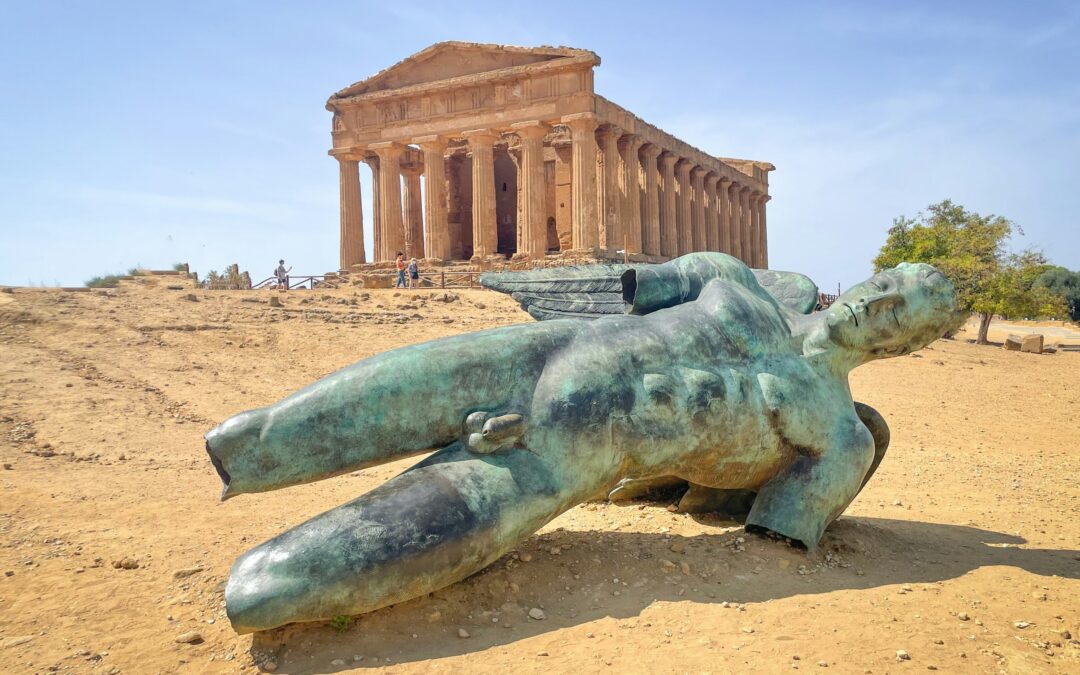
This is the jewel of the site and one of the best-preserved Greek temples in existence. Built around 440 BC, the Temple of Concordia stands almost entirely intact, its 34 Doric columns rising from the limestone ridge against the open sky. The reason for its remarkable survival is significant: in the sixth century AD, it was converted into a Christian church. The alterations that followed, including the blocking of the spaces between the columns, paradoxically protected the structure for centuries.
Standing before it at dawn, when the light is soft and the site is quiet, is one of the finest experiences Sicily has to offer.
2.The Temple of Hera (Juno)
At the eastern end of the ridge, the Temple of Hera occupies the most dramatic position in the park. Twenty-five of its original columns survive, and several of them still bear traces of the fire damage inflicted by the Carthaginians when they sacked the city in 406 BC. Moreover, the view from this end of the ridge, looking west along the full length of the ancient sacred road, is genuinely remarkable.
3.The Temple of Heracles (Hercules)
The oldest temple in the park dates from the late sixth century BC. The Temple of Heracles is largely in ruins, though eight columns were re-erected in the twentieth century. Even in its fragmented state, the scale of what was once here is clear. This was a massive building, constructed to impress both gods and visitors arriving from the sea below.
4.The Temple of Zeus (Olympian Zeus)
Once the largest Doric temple ever constructed, the Temple of Olympian Zeus was begun after the Akragantines’ victory over Carthage at the Battle of Himera in 480 BC. It was, however, never completed. What remains today is a vast field of collapsed masonry. A reconstruction of one of its Telamones, the giant stone figures that once supported the entablature, gives a vivid sense of the building’s extraordinary ambition. The original is housed in the on-site museum.
5.The Temple of Castor and Pollux (Dioscuri)
Only four columns of this temple survive, arranged in a single corner group. Despite its fragmentary state, the Temple of Castor and Pollux has become the most photographed image of the entire site. The columns and the entablature fragment they support have an elegance that photographs exceptionally well, particularly in late afternoon light.
6.The Temple of Hephaestus and the Temple of Asclepius
These two temples, located further from the main ridge, are largely ruined but worth seeking out for those with time. The Temple of Hephaestus sits in the western section of the park. The Temple of Asclepius, associated with healing, once stood near a sacred spring used by pilgrims in antiquity.
The Archaeological Museum
The Regional Archaeological Museum Pietro Griffo, located near the park entrance, is essential for understanding what you are about to see, or have just seen. The collections include:
- The reconstructed Telamon from the Temple of Olympian Zeus
- Extraordinary Greek vases and pottery from the site
- Coins, bronzes and everyday objects from ancient Akragas
- Finds from the surrounding necropolis
Allow at least an hour here. The museum provides the historical and visual context that transforms the temples from beautiful ruins into legible architecture. Additionally, combining the museum visit with the park on a single ticket represents excellent value.
For more on Sicily’s remarkable artistic heritage, our guide to Sicily’s baroque towns of the south-east coast explores another extraordinary chapter of the island’s cultural history.
When is the best time to visit the Valley of the Temples?
This is one of the most important decisions you will make about your visit. The answer depends on what kind of experience you are looking for.
Sunrise
Arriving at the park for opening at dawn is, quite simply, the finest way to experience the temples. The light at this hour is golden and warm. The site is peaceful and quiet. Furthermore, the Temple of Concordia glows in a way that photographs cannot fully capture. If you can manage only one thing on this list, make it this.
Late afternoon
The second-best option is the late afternoon. The light is excellent, particularly on the Temple of Concordia and the Temple of Hera. Crowds thin noticeably after 4pm in the shoulder seasons. Moreover, the temperature drops to something considerably more comfortable for walking.
Why you should avoid midday in summer
The ridge is entirely exposed. There is very little shade available. In July and August, the midday heat on the limestone is intense and genuinely unpleasant. Therefore, if you are visiting in high summer, arriving at opening or late in the afternoon is not optional. It is essential.
Season by season
- Spring (March to May): The ideal season overall. The almond trees that fill the valley bloom spectacularly in late February and early March. Temperatures are pleasant, crowds are manageable and the wildflowers add extraordinary colour to the landscape
- Summer (June to August): Hot and busy. Visit at dawn or late afternoon without exception. Book tickets well in advance
- Autumn (September and October): Excellent conditions. Crowds thin significantly after the summer season and the quality of light is beautiful throughout the day
- Winter (November to February): Very quiet and remarkably atmospheric. Some facilities may have reduced hours. However, the temples in winter, with the site largely empty, are genuinely unforgettable
Tickets and practical information
Do I need to book tickets in advance?
In peak season, yes. Booking online is strongly recommended to avoid queuing at the gate. Tickets can be purchased through the official Valley of the Temples page on Visit Sicily.
What does a standard ticket include?
- Access to the eastern zone (Temple of Concordia, Temple of Hera, Temple of Heracles)
- Access to the western zone (Temple of Zeus, Temple of Castor and Pollux)
- Access to the Archaeological Museum on a combined ticket
Opening hours
The park generally opens at 8.30 am. Closing times vary significantly by season. Additionally, the museum and the park operate on separate opening schedules. Always check the official website before your visit, as hours change throughout the year.
How long does a visit take?
A thorough visit to both the park and the museum takes a full half-day. Most visitors spend between three and five hours on site. If you are combining a sunrise visit with the museum, therefore, allow for a full morning.
Is the site accessible?
The main paths through the park are largely accessible to most visitors. However, the terrain is uneven in places and the limestone surfaces can become slippery when wet. Comfortable, closed-toe shoes are consequently essential.
How to get to the Valley of the Temples
By car
Driving is the most flexible option available. The park is located approximately 3 kilometres south of Agrigento city centre and is clearly signposted from the main roads. Parking is available near the entrance.
By bus
From Agrigento’s central bus station, local buses run regularly to the Valle dei Templi stop. The journey takes approximately fifteen minutes and is straightforward to navigate.
By train
Agrigento is connected by rail to Palermo (approximately two hours) and Catania (approximately three hours with a change). From Agrigento Centrale station, a local bus or taxi will take you directly to the site.
From Palermo
The drive from Palermo takes approximately two hours on the SS189 motorway. Agrigento therefore makes an excellent day trip from Palermo or a natural overnight stop within a broader Sicily itinerary.
Where to stay near the Valley of the Temples
In Agrigento
Staying in Agrigento itself gives you the best access to the site, particularly if you want to visit at sunrise without a long early morning drive. Several hotels in the historic centre offer views towards the temples. A number of excellent agriturismi also operate in the surrounding countryside.
As part of a broader itinerary
The Valley of the Temples sits naturally within a wider Sicily journey. Our Sicily digital travel guide covers the island in comprehensive detail and is designed to work as your practical companion on the road.
What else to do in and around Agrigento
The historic centre of Agrigento
The old city above the temples is often overlooked by visitors focused on the archaeological site. It deserves more attention. The medieval streets, the Cathedral of San Gerlando and the sweeping views down towards the ridge from the upper town are all genuinely worth your time.
The beaches of the southern coast
The coastline south of Agrigento is among the most beautiful in Sicily. The Scala dei Turchi, a brilliant white rocky cliff carved by the sea over centuries, lies just 15 kilometres west of the city. It is one of the most photographed natural landmarks in Italy. The beaches around Porto Empedocle and Eraclea Minoa are furthermore outstanding in their own right. For a broader look at Sicily’s coastline, our guide to the top beaches in Sicily covers the finest options across the island.
Selinunte
An hour’s drive west of Agrigento, Selinunte is the other great Greek archaeological site of southern Sicily. The temples here are largely in ruins. Nevertheless, the scale of the site and the drama of its setting above the sea make it a worthy companion to the Valley of the Temples on any itinerary.
Tips for making the most of your visit
- Arrive at opening. The first hour is the finest on the entire site
- Bring water. The park is exposed and shade is extremely limited throughout
- Wear comfortable shoes. The terrain is uneven in many areas of the park
- Visit the museum. It transforms the experience of the temples entirely
- Stay for sunset. The Temple of Concordia in the last light of the day is extraordinary
- Book tickets online. This is especially important in summer and during the almond blossom festival in February and March
- Allow a full morning. Rushing the Valley of the Temples is a mistake you will regret
Conclusion
The Valley of the Temples in Agrigento is not simply one of the great sites of Sicily. It is one of the great sites of the ancient world. These temples have survived more than two and a half millennia of history, and they remain standing with a dignity that is genuinely moving.
Standing among them, with the sea below and the Sicilian sky above, is an experience that belongs to a very particular category of travel. It is the kind that stays with you long after you have returned home.
Come early. Allow yourself time. Arrive prepared to be surprised by just how affecting ancient stone can be.
Photo: Unplash