

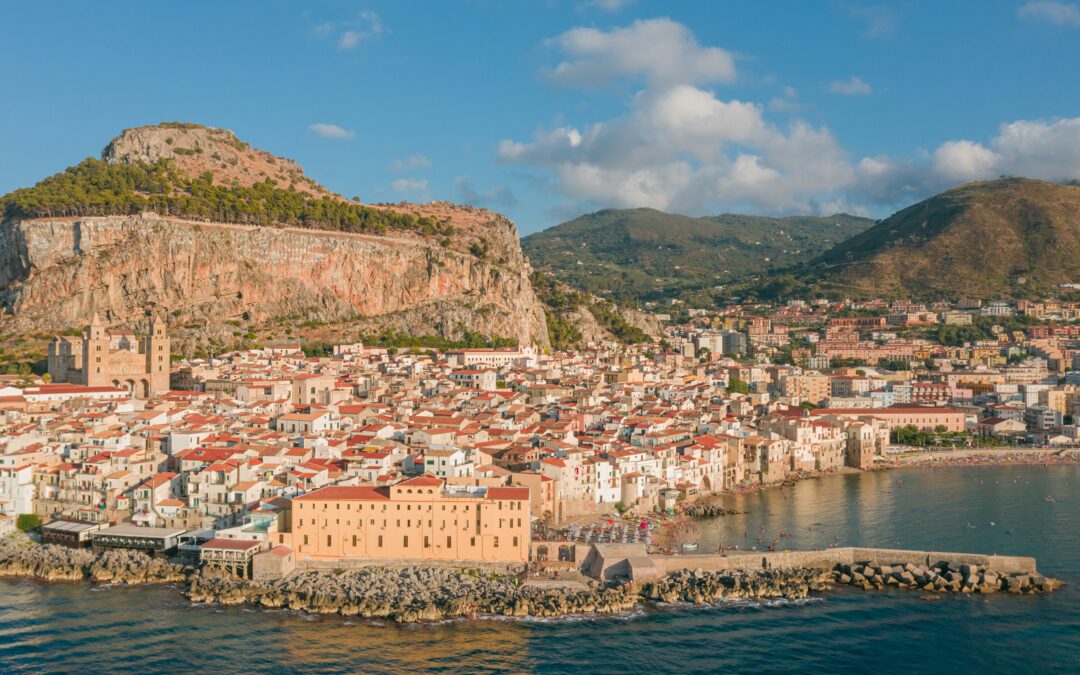
There are towns in Sicily that stop you in your tracks. Cefalù is one of them. Perched between a dramatic limestone rock and the Tyrrhenian Sea, with a Norman cathedral rising above terracotta rooftops and a sandy beach stretching along the waterfront, it is a place that manages to be simultaneously beautiful, historic and genuinely alive.
Whether you are spending a day here from Palermo or building it into a longer Sicily itinerary, Cefalù rewards every hour you give it. The cathedral alone justifies the journey. The beach, the medieval streets and the seafood do the rest.
Why Cefalù belongs on every Sicily itinerary
Cefalù is one of the most visited towns in Sicily, and for very good reason. Few places on the island combine so many extraordinary elements in such a compact and walkable space. The Norman cathedral, begun in 1131 by Roger II of Sicily, is one of the finest examples of Norman architecture in the Mediterranean. The beach is among the best on the northern coast. Furthermore, the medieval old town, with its narrow lanes, Arab-Norman architecture and exceptional seafood restaurants, is a pleasure to explore at any pace.
For those building a broader Sicily itinerary around this visit, our guide to Sicily’s cities covers the best urban destinations across the island in detail. Understanding how Cefalù fits into the bigger picture makes the visit significantly more rewarding.
The Norman cathedral: one of Sicily’s greatest buildings
The Cefalù Cathedral, officially the Cattedrale di Cefalù, dominates the town from every angle. Rising above the main piazza with two square towers and a facade of extraordinary refinement, it is immediately recognisable as one of the great Norman buildings of the Mediterranean world.
Construction began in 1131, commissioned by Roger II of Sicily following a vow made during a violent storm at sea. The king credited his survival to divine intervention and built the cathedral as an act of gratitude. Work continued for decades, producing a building that blends Norman, Byzantine and Arab architectural traditions in a way that is entirely unique to Sicily.
The interior is where the cathedral reveals its true character. The apse mosaic of Christ Pantocrator, dating from around 1148, is one of the finest Byzantine mosaics in existence. The figure of Christ, rendered in gold tesserae against a deep blue background, fills the entire apse with a presence that is genuinely overwhelming. Many visitors consider it the single most powerful image in Sicily.
For visiting hours, ticket information and the latest updates, the Cefalù Cathedral is the most reliable source available.
What to look for inside the cathedral
- The Christ Pantocrator mosaic in the apse, dating from approximately 1148;
- The Virgin and Child mosaic on the triumphal arch;
- The carved wooden ceiling in the nave, one of the finest of its kind in Sicily;
- The cloister, a quiet and beautifully preserved Norman space adjacent to the main building;
- The episcopal throne and the medieval floor tiles in the presbytery.
Is the Cefalù cathedral worth the entrance fee?
Absolutely. The cathedral is the finest Norman building in Sicily after the Palatine Chapel in Palermo. The Pantocrator mosaic alone makes the visit exceptional. Furthermore, the cloister and the surrounding piazza, with its views up to the Rocca above, are among the most atmospheric spaces in the entire town. Allow at least an hour here, and consider arriving early in the morning before the tour groups arrive.
For a complete guide to what to see in the town beyond the cathedral, the Cefalù guide covers all the main attractions in detail.
The beach: Cefalù’s other great attraction
The Cefalù beach stretches along the eastern edge of the old town, framed by the medieval walls on one side and the open sea on the other. It is a long, gently curving arc of fine sand with clear, calm water that is ideal for swimming from late May through to October.
The beach divides naturally into two sections:
- The free beach: A wide stretch of public sand at the eastern end, accessible to all without charge. It becomes extremely busy in July and August but remains manageable in June and September;
- The lido area: A series of private beach clubs with sun loungers, umbrellas and changing facilities available for a daily fee. These fill quickly in peak season and advance booking is recommended.
When is the best time to use the beach?
June and September are ideal. The water is warm, the crowds are significantly thinner than in July and August and the light on the water in the late afternoon is extraordinary. July and August bring the largest crowds and the highest temperatures. Arriving at the beach early in the morning or after 5pm is the only reliable strategy for space and comfort during these months.
For more on how to make the most of Sicily’s beaches and how to navigate the island during the summer season, our guide to summer in Sicily covers the essential dos and don’ts in detail.
The old town: medieval streets and Arab-Norman architecture
Beyond the cathedral and the beach, Cefalù’s old town is one of the most rewarding historic centres in Sicily. The street plan preserves the original Arab-Norman layout of the medieval town, with narrow lanes, stone arches and small piazzas that have changed little in centuries.
The Osterio Magno, a medieval palace on Corso Ruggero, is believed to have served as a royal residence during the Norman period. The Lavatoio Medievale, a public washhouse fed by a natural spring, is one of the most atmospheric spaces in the town. Furthermore, the Via Vittorio Emanuele and the Lungomare, the seafront promenade, offer contrasting but equally enjoyable perspectives on the town.
For a complete overview of the town’s history, attractions and practical visitor information, the Visit Cefalù website is the best starting point for planning your visit.
The Rocca: the rock above the town
Rising dramatically behind the old town, the Rocca di Cefalù is a limestone outcrop that reaches 268 metres above sea level. A steep path from the old town leads to the summit, passing through the remains of a megalithic temple, medieval fortifications and extraordinary panoramic viewpoints.
The climb takes approximately 30 to 40 minutes at a comfortable pace. The views from the top, taking in the full sweep of the coastline, the old town below and the open sea beyond, are among the finest in northern Sicily.
Practical information for the Rocca
- Opening hours: Vary by season. Check locally before attempting the climb;
- Duration: 30 to 40 minutes to the summit, the same to return;
- Difficulty: Moderate. The path is steep and uneven in places. Suitable footwear is essential;
- Best time: Early morning or late afternoon. Midday in summer is extremely hot on the exposed rock.
What to eat in Cefalù
Cefalù has an excellent food scene, particularly for seafood. The town’s position on the northern Sicilian coast gives it access to some of the finest fish and shellfish in the region.
- Pasta con le sarde: The great Sicilian pasta dish, with fresh sardines, wild fennel, pine nuts and raisins;
- Spaghetti ai ricci di mare: Sea urchin pasta, intensely flavoured and deeply Sicilian;
- Pesce spada alla siciliana: Swordfish cooked with tomatoes, olives and capers in the classic Sicilian style;
- Arancini: The rice balls found across Sicily, but particularly good at the street food stalls near the beach;
- Granita di mandorla: Almond granita, one of the finest cold drinks in Sicily and a Cefalù speciality.
The restaurants along the Lungomare and in the lanes behind the cathedral offer the best combination of quality and atmosphere. Avoid the most obviously tourist-facing places on the main piazza and explore the side streets for better value and more authentic cooking.
Cefalù as a day trip from Palermo
Cefalù is one of the most popular day trips from Palermo, and for very good reason. The town is approximately 70 kilometres east of the Sicilian capital, connected by a fast and scenic coastal rail line.
Getting from Palermo to Cefalù
- By train: The most convenient option. Direct services run frequently from Palermo Centrale to Cefalù station, with the journey taking approximately one hour. The coastal route, passing through tunnels and along the sea, is genuinely scenic;
- By car: Driving takes approximately one hour on the A19 and A20 motorways. Having a car allows flexibility for stopping along the coast but is not essential for a Cefalù day trip;
- By organised tour: Several operators run day trips from Palermo that include guided visits to the cathedral and the old town.
How long to spend in Cefalù
A day trip from Palermo gives you enough time to visit the cathedral, walk the old town, swim from the beach and eat lunch at a good restaurant. Arriving by the first morning train and returning on a late afternoon service is the most efficient approach. Those who want to explore the Rocca as well should allow a full day from early morning.
For those who want a personalised recommendation on how to structure a Cefalù visit within a broader Sicily trip, our basic Sicily travel consultation service is the ideal starting point.
Combining Cefalù with a broader Sicily visit
Cefalù sits naturally within a northern Sicily itinerary that might also include Palermo, the Aeolian Islands and the extraordinary Valle dei Templi at Agrigento. The town is also within easy reach of the Parco delle Madonie, a mountain nature reserve with medieval villages, excellent hiking and outstanding local food.
For a complete overview of Sicily’s best destinations and how to connect them into a coherent journey, the Sicily guide to Cefalù provides useful context on the town’s place within the broader island.
Those wanting a completely personalised Sicily itinerary that includes Cefalù, Palermo and the best of the northern coast can explore our tailor-made Sicily itinerary service, designed to create a journey that fits your interests, pace and timing perfectly.
Practical information for visiting Cefalù
Getting there
- By train from Palermo: approximately one hour, frequent daily services;
- By car from Palermo: approximately one hour on the motorway;
- By car from Catania: approximately two hours.
Getting around
The old town is entirely walkable. Everything worth seeing is within a comfortable 15-minute walk of the train station. A car is not needed for the town itself but is useful for exploring the surrounding coast and the Madonie mountains.
When to visit
- May, June and September: Ideal. Warm enough for the beach, thin enough crowds to enjoy the cathedral and old town in comfort;
- July and August: Peak season. Hot, crowded and expensive but atmospheric. Book accommodation well in advance;
- October to April: Quiet and very atmospheric. The beach is not swimmable but the town, the cathedral and the food are all at their best.
Where to stay
Staying overnight in Cefalù is highly recommended. The town after the day-trippers leave is a significantly different, quieter and more local experience. Several excellent small hotels and bed and breakfasts operate within the old town walls.
Conclusion
Cefalù is one of those Sicilian towns that justifies the journey entirely on its own terms. The Norman cathedral is extraordinary. The beach is among the finest on the northern coast. The old town rewards slow and unhurried exploration in a way that few places in Sicily can match.
Come for the day from Palermo if that is all you have. Stay longer if you possibly can. Either way, Cefalù Sicily will give you considerably more than you expect.
Photo: Unplash