

Indeed, you have almost certainly eaten Marsala without ever thinking about where it comes from. It hides in restaurant kitchens worldwide, in pan sauces, in zabaglione and in the cream inside a cannolo. Yet Marsala is a real place: a sunlit, low-slung city on the westernmost tip of Sicily.
It is also one of the island‘s most underrated destinations. Here you will find historic wine cellars, salt pans worked by hand, a Phoenician island and a food culture shaped by North Africa. This guide covers what to drink, what to eat and what to see.
What is Marsala wine, exactly?
Marsala is a fortified wine, which means a neutral grape spirit is added during production. That is the same family as Sherry, Port and Madeira, and it is why the bottle survives months on a shelf.
- The grapes: mainly Grillo, alongside Catarratto, Inzolia and Damaschino for the white styles;
- The colours: Oro (gold), Ambra (amber) and Rubino (ruby, from red grapes);
- The sweetness: Secco (dry), Semisecco (medium) and Dolce (sweet);
- The protection: Marsala received DOC status in 1969, among the first Italian wines to do so.
Above all, the ageing categories are what separate a cooking bottle from a serious one. In practice, the words on the label tell you almost everything.
- Fine: aged around one year, the everyday style;
- Superiore: at least two years, with Riserva at four;
- Vergine or Soleras: at least five years, always dry and never sweetened;
- Vergine Riserva or Stravecchio: at least ten years, the summit of the category.
How did an English merchant invent it?
Indeed, the story of Marsala starts with bad weather. In 1773, a Liverpool merchant named John Woodhouse sheltered in the port and tasted a local wine aged in wooden casks.
Naturally, the wine reminded him of the Spanish and Portuguese bottles then fashionable in England. To survive the sea journey home, he added brandy to the barrels, and the modern style was born.
- The British wave: Benjamin Ingham and the Whitaker family followed and built their own cellars;
- The Sicilian answer: Vincenzo Florio founded his cellars in the 1830s, between his British rivals;
- The consolidation: Florio later bought out Woodhouse and the other historic houses;
- The result: Marsala became one of Sicily‘s richest industries of the nineteenth century.
Naturally, the cellars still tell that story today, and the British names are still on the barrels. Sicily’s other great wine story unfolds on the far side of the island, and our guide to Etna wine tasting explains how volcanic soil shaped it.
Why did Marsala lose its reputation?
In truth, this is the part most wine lovers never hear. During the twentieth century, producers began selling flavoured versions with eggs, coffee or bananas, sold cheaply as kitchen wine.
In fact, a 1984 law banned those additives and tightened the rules, but the damage was done. Marsala became a bottle people cooked with rather than drank, and the great dry styles were forgotten outside Italy.
- The revival: a handful of producers now focus on bone-dry Vergine styles;
- The flavours: expect walnut, dried apricot, orange peel and a salty edge;
- The serving: chilled, as an aperitif, rather than only with dessert;
- The pairing: aged cheeses, almonds and Modica chocolate.
In practice, the classic pairing is a square of grainy Modica chocolate, and our guide to Modica chocolate explains why that ancient recipe sits so well beside a sweet Marsala. The two share the same Sicilian logic of few ingredients treated with patience. Meanwhile, tasting a ten-year Vergine Riserva next to a supermarket bottle is genuinely startling. They barely feel like the same drink.
Which cellars can you visit?
Naturally, this is the reason most travellers come. Several historic wineries sit within a few minutes of the seafront, many inside old fortified courtyard estates.
- Florio: vast tuff-stone cellars from the 1830s, with tours ending in guided tastings;
- Pellegrino: a family house founded in 1880 and still run by the same family;
- Donnafugata: celebrated for modern Sicilian wines as well as Marsala;
- Small producers: several artisan estates nearby focus on traditional methods.
The official history published by Cantine Florio tells how a storm, a merchant and a barrel of brandy changed an entire coastline. In practice, book tours in advance, especially between June and September, when the cellars are busiest.
What do people eat in Marsala?
Above all, western Sicily eats differently from the rest of the island. This coast faces North Africa, and the kitchen has absorbed centuries of that influence.
- Fish couscous: the signature dish of this province, steamed and served in seafood broth;
- Busiate with pesto alla trapanese: twisted pasta with almonds, tomato and basil;
- Raw and grilled seafood: red prawns, tuna and whatever the lagoon boats bring in;
- Sea salt: harvested beside the city and recognised as a Slow Food product.
Indeed, the restored fish market near the old city gate is the best place to feel this. By day it sells the catch, and by night it fills with wine bars and late dinners. Our guide to what to eat in Sicily puts these dishes in context across the island. For special occasions, our roundup of the best restaurants in Sicily covers the finest tables in the region.
The salt pans: Sicily’s strangest landscape
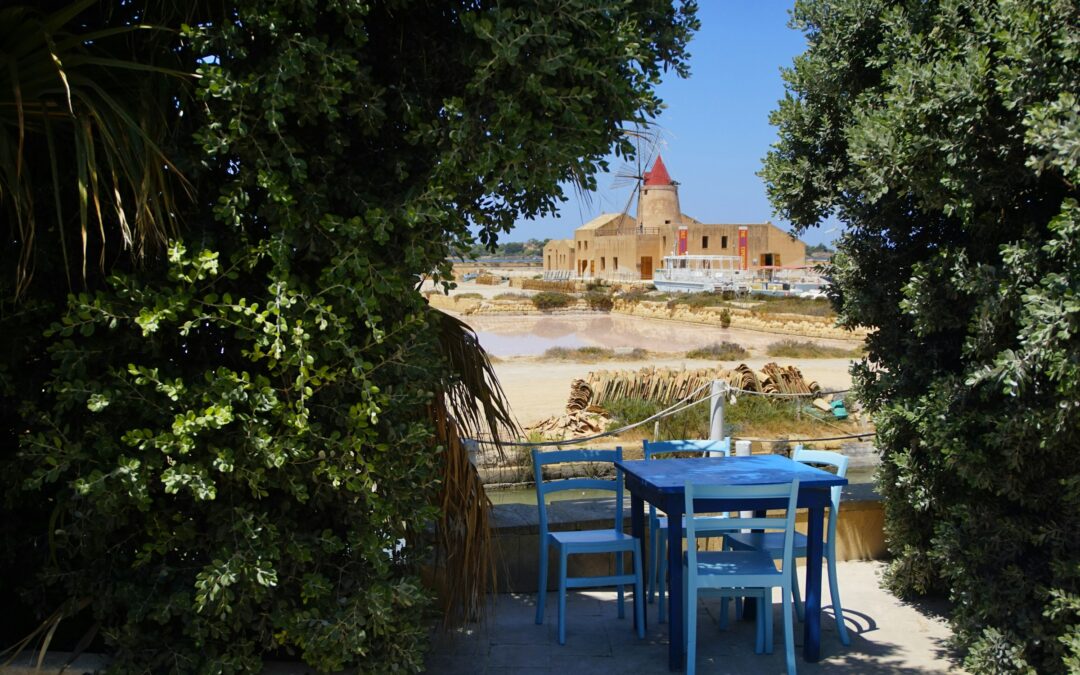
Meanwhile, just north of the city lies the Stagnone lagoon, a shallow, protected stretch of water where salt has been harvested for centuries. It is one of the most photographed landscapes in western Sicily.
- The windmills: restored stone mills once pumped water between the basins;
- The colours: the pools shift from pink to silver depending on season and light;
- The salt: still gathered by hand and piled into white mounds under terracotta tiles;
- The timing: come at sunset, when the water turns into a mirror.
Meanwhile, the shallow, windy lagoon has also made this coast a magnet for kitesurfing. In fact, few places in Europe let you watch salt workers and kite sails share the same horizon.
Mozia: a Phoenician city on an island
Above all, in the middle of the lagoon sits Mozia, also called Motya, one of the oldest Phoenician settlements in the Mediterranean. A short boat crossing takes you there from the historic landing stage.
The island belongs to the Whitaker Foundation, named after the English wine family who bought it and began excavations. Naturally, that connection ties the archaeology directly back to the wine trade.
- The walls: walk the ancient fortifications around the whole island;
- The museum: home to the celebrated marble Youth of Mozia, found in 1979;
- The mystery: scholars still debate whether he is a charioteer, an athlete or a god;
- The setting: vineyards, salt and sea, all on a tiny island.
The official Visit Sicily page for Mozia explains the crossing and what survives on the island. That said, allow at least half a day to do it properly.
What to see in the town itself
In practice, the historic centre is small enough to walk in a couple of hours. It is also where Italian history took a decisive turn.
- Porta Garibaldi: the gate where Giuseppe Garibaldi entered after landing here on 11 May 1860;
- Via XI Maggio: the main street, lined with baroque palaces and evening strollers;
- The Mother Church: dedicated, remarkably, to Saint Thomas of Canterbury;
- Lilybaeum archaeological park: home to a rare Punic warship raised from the sea.
The Visit Sicily walking guide to the centre maps the route between the gates. Meanwhile, the official Italian tourism page for Marsala gives a useful overview of the wider area, and traveller reviews on Tripadvisor are handy for opening times.
How should you drink Marsala at home?
In practice, back home the bottle deserves better than the back of a cupboard. A good Marsala behaves like a sherry, so treat it the same way.
- Dry styles: serve lightly chilled as an aperitif, with olives or aged cheese;
- Sweet styles: pour at room temperature beside almond pastries or dark chocolate;
- In the kitchen: use a drinkable bottle, never one labelled for cooking only;
- After opening: fortified wine keeps for weeks, not days, once resealed.
In fact, the classic pan sauce works far better with a real Superiore. The difference in the finished dish is immediate.
How do you get to Marsala?
Conveniently, the city sits close to a small international airport. That makes western Sicily far easier to reach than most travellers expect.
- From Trapani airport: roughly 20 minutes by car;
- From Palermo: about two hours by road;
- By train: slow but scenic services connect Trapani and Palermo;
- A car helps: essential for the salt pans, the wineries and the lagoon.
Our guide to car hire and driving in Sicily covers pick-up, parking and local rules. Above all, a car turns this region from difficult into effortless.
Beyond the city: what else is nearby?
Meanwhile, this corner of the island packs an extraordinary amount into a short drive. Everything below sits within about an hour.
- Erice: a medieval hill town above the clouds, famous for almond pastry;
- Trapani: a working port with more salt pans and ferries to the islands;
- Favignana: the largest of the Egadi Islands, with turquoise coves;
- Segesta: a lone Greek temple standing in open countryside.
Naturally, that variety is why many travellers base themselves here for several nights. In practice, you can swim, taste wine and walk through ruins in a single day.
How long should you stay?
Naturally, many travellers treat Marsala as a day trip, which is a mistake. The town rewards an overnight stay, mostly because of the light.
- One day: a cellar tour, lunch and the salt pans at sunset;
- Two days: add Mozia and the archaeological park;
- Three days: include Erice, Trapani and the nearby islands;
- Best seasons: spring and autumn, for mild days and the harvest.
For a wider route, our one week in Sicily itinerary shows how the west fits alongside the island‘s better-known east. Indeed, most first-time visitors skip this coast entirely, which is exactly why it stays calm.
Taste it where it was invented
Marsala is that rare place where a word you have read on menus all your life turns into a real city, with salt on the wind and barrels in the dark. Taste the dry version first, then watch the sun drop behind the windmills. You will never look at that bottle the same way again.
Cellar tours need booking, the salt pans need the right hour and the best tables fill fast in high season. We help travellers put western Sicily together so that the wine, the food and the light all line up. Book a free call with our Sicily trip planning concierge, and let us plan it with you.
Photo: Unplash