

Step inside a chapel in Palermo and you may forget which century, or even which civilisation, you are standing in. Above you, golden Byzantine mosaics shimmer. Beside you, Arabic inscriptions curl across the walls. Overhead, a wooden ceiling built by Islamic craftsmen glows with painted stars.
This is Arab-Norman Palermo, one of the most extraordinary cultural fusions on earth. For a brief, brilliant moment in the Middle Ages, Christians, Muslims and Jews built a shared civilisation here, and the buildings they left behind are unlike anything else in Europe.
In 2015, UNESCO recognised this legacy as a World Heritage Site. So if you are planning a trip, here is your complete guide to Arab-Norman Palermo: the history, the must-see monuments, and how to experience them.
What does “Arab-Norman” actually mean?
The story is remarkable. In the 9th century, Arab rulers transformed Sicily, bringing citrus, irrigation, new foods and dazzling architecture. Then, in the 11th century, Norman knights from northern France conquered the island.
Crucially, however, the Normans did not erase what they found. Instead, they embraced it. As a result, they kept Arab craftsmen, Byzantine mosaic artists and local builders working side by side. The style that emerged, Arab-Norman, blends Islamic geometry, Byzantine gold and Western Romanesque structure into something entirely new.
- Islamic influence: geometric patterns, muqarnas ceilings and Arabic script woven into Christian buildings;
- Byzantine influence: shimmering gold mosaics depicting saints, emperors and biblical scenes;
- Norman influence: the sturdy Romanesque structure that holds the whole fusion together;
- The result: a style found nowhere else in the world, born of tolerance rather than conquest.
Indeed, for a few generations, Palermo was one of the richest, most cultured and most tolerant cities in the Mediterranean. The monuments of Arab-Norman Palermo are what survive of that golden age.
The Palatine Chapel: the jewel of Arab-Norman Palermo
If you see only one thing, make it the the Palatine Chapel inside the Norman Palace. Built by King Roger II in the 12th century, it is widely considered one of the most beautiful interiors in the world.
In fact, look closely and the fusion is everywhere. The walls glow with Byzantine gold mosaics. The floor is laid in Islamic-style marble patterns. And above it all hangs a breathtaking muqarnas ceiling, a honeycomb of carved wood built by Arab craftsmen and painted with scenes of daily life.
- The ceiling: one of the finest surviving examples of Islamic wooden craftsmanship anywhere;
- The mosaics: among the best-preserved Byzantine gold work outside Constantinople;
- The setting: still housed inside a working seat of government, not a museum piece;
- The scale: small enough to feel intimate, rich enough to overwhelm.
Naturally, the surrounding Norman Palace is still the seat of the Sicilian Regional Assembly. That makes it one of the oldest royal residences in Europe still in active use today. For those building a longer stay, our one week in Sicily itinerary shows exactly where a morning at the chapel fits best.
Palermo Cathedral: layers of history in one building
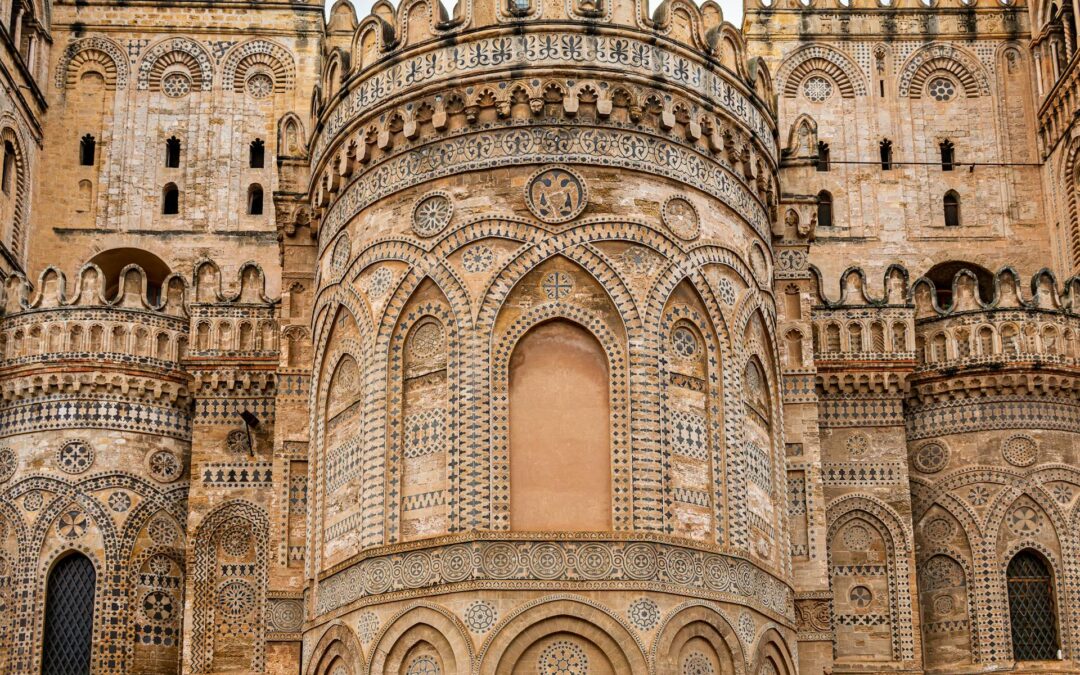
Nearby, a short walk away, the vast Palermo Cathedral tells the whole island‘s story in a single façade. Founded in 1185, it stands on the site of an earlier mosque, which itself replaced a Christian church.
Naturally, over the centuries, the building absorbed Norman, Gothic, Catalan, Baroque and Neoclassical additions. Therefore it can look almost chaotic, and yet it is utterly captivating. Inside rest the tombs of Sicily‘s medieval kings, including Roger II and the great emperor Frederick II.
- A layered façade: five centuries of architectural styles stacked into one building;
- Royal tombs: the resting place of some of medieval Europe’s most powerful rulers;
- A hidden detail: a column on the southern porch still carries a verse from the Quran, left over from the building’s time as a mosque;
- Free to enter: the main body of the cathedral remains open to all visitors.
Indeed, that Quranic verse is a small, astonishing reminder of the city’s layered past. It hides in plain sight for anyone who knows where to look. History lovers will find an equally powerful counterpart at the Valley of the Temples in Agrigento, Sicily’s greatest ancient site.
The Martorana and San Cataldo
Meanwhile, in the heart of the city, two more gems sit side by side on Bellini Square. The Martorana dazzles with some of the finest Byzantine mosaics in Italy, including a famous image of King Roger II being crowned by Christ himself.
Meanwhile, next door, the tiny church of San Cataldo is unmistakable, crowned with three rosy-red domes that look purely Arabic. Together, the two buildings capture, in a single glance, everything that makes Arab-Norman Palermo so special.
San Giovanni degli Eremiti and La Zisa
Naturally, two more sites complete the picture. San Giovanni degli Eremiti, with its red domes and peaceful cloister garden, feels almost like a building transplanted from Cairo or Marrakech.
Meanwhile, La Zisa is a former Norman summer palace designed in pure Arab style, complete with cooling water channels and a museum of Islamic art. The name itself comes from the Arabic al-Aziz, meaning “the splendid“.
- San Giovanni degli Eremiti: famous for its distinctive red domes and tranquil garden;
- La Zisa: engineered with a sophisticated cooling system centuries ahead of its time;
- Both sites: quieter than the cathedral and chapel, ideal for a slower, reflective visit;
- The theme: proof that the Arab-Norman style extended well beyond religious buildings.
The Arab legacy beyond architecture
The Arab influence on Sicily runs far deeper than any single building. Nine centuries later, everyday life across the island still carries traces of that era, often in ways visitors never expect.
- Citrus and pistachios: introduced by Arab farmers, still central to Sicilian cuisine today;
- Irrigation systems: Arab engineering transformed once-dry land into fertile farmland;
- Place names: countless Sicilian towns still carry Arabic-derived names, including Marsala and Calatafimi;
- Cous cous: a staple in western Sicily to this day, a direct culinary inheritance from North Africa.
In fact, that layered inheritance is exactly why Sicily feels so distinct from mainland Italy. Arab-Norman Palermo is simply where that inheritance is easiest to see, carved into stone and gold.
Monreale and Cefalù: the cathedrals beyond the city
In practice, the UNESCO site does not stop at the city limits. Two of its greatest treasures lie just outside Palermo, each easily reached in a single day.
The Cathedral of Monreale, on the hills above the city, is covered with over 6,000 square metres of golden mosaics, one of the largest mosaic cycles in the world. Its cloister, ringed by 228 carved columns, is equally unforgettable.
Meanwhile, to the east, the Cathedral of Cefalù rises above a beautiful seaside town, its apse filled with a serene mosaic of Christ Pantocrator. Naturally, our guide to Cefalù shows how to combine this masterpiece with a perfect beach day.
Getting to Palermo and around the sites
In practice, reaching Arab-Norman Palermo has become considerably easier in recent years, with growing direct flight connections into the city. Getting between the sites themselves is equally straightforward once you arrive.
- By air: Palermo‘s airport connects to a growing number of international routes each year;
- Within the city: the Palatine Chapel, Cathedral, Martorana and San Cataldo all sit within a short walk of each other;
- To Monreale: a quick bus or taxi ride from central Palermo, roughly twenty minutes;
- To Cefalù: under an hour by train, making it an easy add-on to a Palermo-based stay.
How to visit Arab-Norman Palermo
Above all, the good news is that the main sites sit within easy walking distance of central Palermo. A few tips will help you make the most of the day.
- Buy a combined ticket where available, to cover several monuments at once;
- Visit the Palatine Chapel early to beat the crowds and catch the best light on the mosaics;
- Check opening times carefully: some sites close on certain afternoons or for events;
- Set aside a half-day for Monreale, which deserves unhurried time rather than a rushed stop.
In practice, spreading these sites across two calmer days beats trying to rush everything into one. The mosaics reward patience far more than speed.
Beyond the monuments: living, modern Palermo
Above all, while you are exploring, do not forget that Palermo is also a genuine food capital. Our Palermo street food guide and our Palermo street art walking guide reveal the living, modern city that surrounds these ancient wonders.
- Street food: panelle, arancine and sfincione, sold from stalls just steps from the cathedral;
- Street art: vivid modern murals covering entire buildings in the city’s old quarters;
- Local markets: the Vucciria and Ballarò markets buzz with the same energy centuries of traders once brought;
- A living city: the same layered, tolerant spirit still shapes Palermo‘s culture today.
And if your visit coincides with July, the city’s spectacular patron-saint festival is unmissable. Our guide to the Santa Rosalia festival in Palermo tells you everything worth knowing before you go.
When to visit, and how much time to allow
Naturally, timing shapes the whole experience. The Palatine Chapel and Monreale both reward a quieter moment, away from peak midday crowds.
- Best months: spring and autumn bring mild weather and thinner crowds than midsummer;
- Minimum time: a full day covers the city-centre sites comfortably;
- Ideal time: two to three days allows Monreale and Cefalù without feeling rushed;
- Morning light: the best hours for photographing the mosaics, before crowds and heat build.
Why this history still matters today
In truth, it would be easy to treat Arab-Norman Palermo as a curiosity from a distant past. Instead, its message feels remarkably current, a reminder that different faiths and cultures once chose collaboration over conflict.
Above all, that choice produced some of the most beautiful buildings in human history. Standing beneath the Palatine Chapel’s ceiling, it is hard not to wonder what more the world might build with a little more of that same spirit.
How can Time for Sicily help?
Arab-Norman Palermo is not just a collection of monuments. It is the story of a time when different cultures chose to build something beautiful together, a message that feels as powerful today as it did nine centuries ago.
To experience it fully, our local experts can build a route around Palermo, Monreale, Cefalù and the island’s other treasures, handling the tickets, timing and local guides. Book a free call with our Sicily trip planning concierge, and all you have to do is look up, and marvel.
Nine centuries later, still unlike anywhere else
Few places on earth let three great civilisations sit this close together, gold beside geometry, dome beside column, all under one roof. Arab-Norman Palermo remains proof that beauty, at its best, is built together. Come for the mosaics. Stay for a Sicily unlike any other.
Photo: Unplash