

When people search for things to do in Catania, many have only seen the city through an airport window, on the way to Taormina or Mount Etna. That is a mistake. Sicily‘s second city is loud, black and gold, built from lava stone and rebuilt in baroque splendour, with a volcano smoking quietly on the horizon.
Indeed, the things to do in Catania are some of the most vivid on the island: a fish market in full voice, Roman ruins wedged between apartment blocks, and some of Sicily‘s best street food. This guide covers what to see, what to eat and where to stay.
Why is Catania worth visiting?
Above all, because nowhere else in Italy looks like it. The city was founded by Greek settlers in the 8th century BC, destroyed several times by Etna and by earthquakes, and rebuilt each time from the very lava that threatened it.
- UNESCO baroque: the historic centre belongs to the World Heritage late baroque towns of the Val di Noto;
- Lava architecture: dark volcanic stone gives the streets their black and cream colour;
- A former capital: Catania was capital of the Kingdom of Sicily in the early 1400s;
- A living city: students, markets and nightlife keep it real, not a museum.
Naturally, the volcano is never out of sight. Our guide to hiking Mount Etna explains how to climb it from the city, which is one of the main reasons people base themselves here.
Piazza del Duomo and the Elephant Fountain
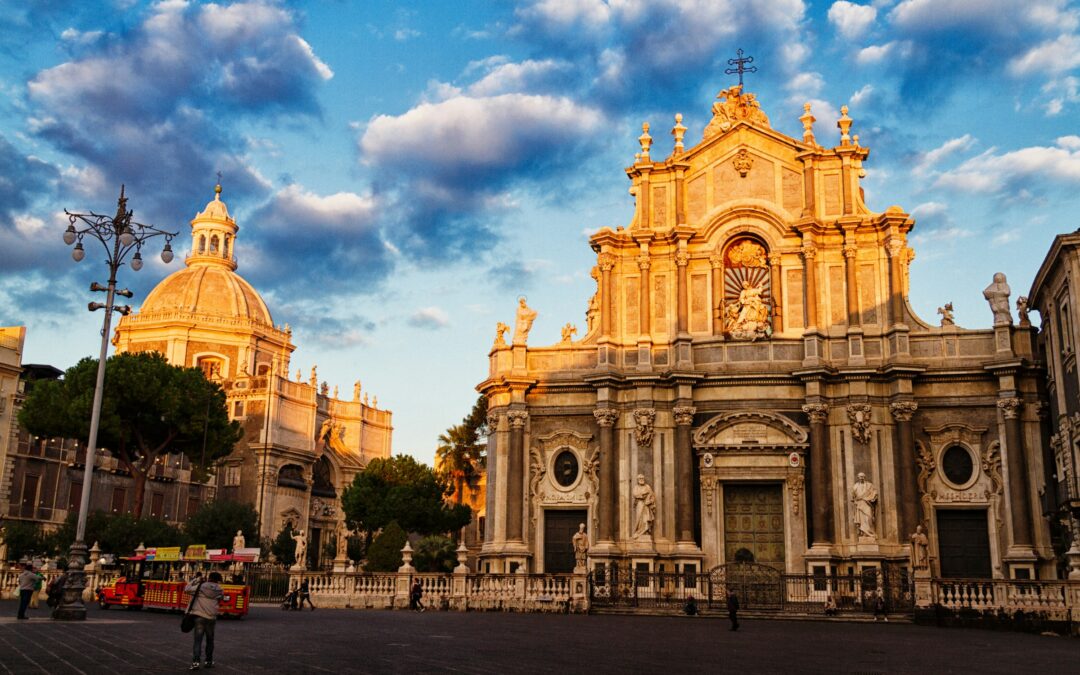
In practice, every visit starts in Piazza del Duomo, the heart of the city. Its current layout dates from the 18th century, and almost every building around it is a baroque showpiece.
- The Elephant Fountain: a lava-stone elephant called “Liotru”, the city‘s symbol, believed to protect it from eruptions;
- The Cathedral of Sant’Agata: dedicated to the patron saint, whose relics are kept inside;
- Palazzo degli Elefanti: the elegant town hall on the north side of the square;
- The Badia di Sant’Agata: a church whose dome offers one of the best views of Etna.
The official Sicilian portal’s tour to discover Catania traces a route from Piazza Duomo through the main squares and baroque streets. Meanwhile, Italy’s national tourism site describes the city as one of the great centres of Sicilian baroque on its Catania page.
La Pescheria: the fish market
Naturally, nothing captures Catania like its fish market. Just behind the cathedral, down a flight of steps, La Pescheria fills a square with shouting traders, swordfish heads and ice glittering under the morning sun.
- When to go: early morning, ideally before 11, when the market is at its loudest;
- What you will see: swordfish, tuna, sea urchins and anchovies by the crate;
- Where to eat: small trattorias around the market cook the catch at lunch;
- Closed: on Sundays, when the square falls silent.
Above all, keep your camera ready and your bag close. It is a working market, not a show, and that is exactly why it is unforgettable.
What are the best things to do in Catania?
Meanwhile, beyond the square and the market, the other things to do in Catania reward a slow walk. Most of the highlights sit within a twenty-minute stroll of the cathedral.
- Via Etnea: the main street, running straight towards Etna through shops and cafés;
- Via dei Crociferi: a short street lined with baroque churches, perhaps the most beautiful in the city;
- The Benedictine Monastery: one of the largest monastic complexes in Europe, now part of the university;
- The Roman Theatre: an ancient theatre hidden among residential buildings in the old centre;
- Ursino Castle: a 13th-century fortress, now home to the civic museum.
Above all, for opening times and current visitor reviews, Tripadvisor’s list of things to do in Catania is a practical companion. Indeed, many of these sights are free to see from the outside.
What are the free things to do in Catania?
In truth, some of the best things to do in Catania cost nothing at all. The city’s beauty is mostly outdoors, in its squares, streets and markets.
- Piazza del Duomo: the Elephant Fountain and the cathedral facade, free at any hour;
- La Pescheria: walking through the fish market costs only your attention;
- Villa Bellini: the public garden, with views towards Etna on clear days;
- Via dei Crociferi: a walk past the city’s finest baroque churches.
Meanwhile, the seafront offers a different kind of freedom. Indeed, the black volcanic rocks at San Giovanni Li Cuti are where locals swim in summer, a short walk from the centre.
The Teatro Massimo Bellini
Meanwhile, music lovers have a reason of their own to come. Catania is the birthplace of the composer Vincenzo Bellini, and the opera house named after him opened in 1890.
- The building: a lavish 19th-century theatre in the heart of the centre;
- The curtain: a celebrated historic painted curtain worth seeing in itself;
- The season: opera, concerts and ballet through the winter months;
- Villa Bellini: the city‘s main public garden, also named after the composer.
How many days do you need in Catania?
In practice, two full days cover the city itself comfortably, with a third for Etna. Most of the things to do in Catania are close together, so the time goes into food and day trips rather than transport.
- One day: the market, Piazza Duomo, Via dei Crociferi and the Benedictine Monastery;
- Two days: add the Roman Theatre, Ursino Castle and an evening on Via Etnea;
- Three days: include Mount Etna or the coast at Aci Trezza;
- Four or more: use the city as a base for Taormina and Syracuse.
Meanwhile, the city changes character after dark. Indeed, Catania has one of the liveliest nightlife scenes in Sicily, thanks to its large student population.
What to eat in Catania
In truth, Catania is one of the great food cities of Sicily, and much of the best eating happens on the street. Many of its sweets are dedicated to Saint Agatha, the patron saint.
- Arancino: fried rice balls, pointed in Catania, round in Palermo, and named in the masculine here;
- Pasta alla Norma: aubergine, tomato and salted ricotta, named after Bellini’s opera;
- Granita and brioche: the classic Sicilian breakfast, best eaten before ten;
- Seltz al limone: a fizzy lemon and salt drink from the city‘s street kiosks.
In truth, for the background, the national portal’s guide to Catania’s history and specialities explains how food and faith intertwine here. Our own guide to Sicilian granita and brioche shows how to order breakfast like a local.
Where to stay in Catania
In practice, the choice comes down to whether you want the old town or the seafront. Both are good bases for day trips across eastern Sicily.
- Historic centre: around Piazza del Duomo and Via Etnea, ideal for walking everywhere;
- Via dei Crociferi area: quieter streets, still close to the sights and restaurants;
- Corso Italia: the more upmarket seafront district, with wine bars and parking;
- Near the airport: only for an early flight, since the centre is a short drive away.
In practice, the Visit Sicily tourist information page lists the Catania office right on Via Etnea, a useful first stop for maps and advice. Meanwhile, Tripadvisor’s Catania travel guide gathers traveller tips on hotels and restaurants.
How do you get to Catania?
Conveniently, Catania airport is the busiest in Sicily, and it is only a short drive from the centre. It is also the arrival point for the island‘s direct flights from the United States.
In practice, our guide to Delta’s year-round flights from New York to Catania covers the simplest route across the Atlantic. Meanwhile, our article on United Airlines flights to Catania explains the new Newark connection arriving in 2027.
What day trips can you take from Catania?
Above all, Catania‘s real gift is its position, which adds day trips to the list of things to do in Catania. Some of the island‘s most famous places are within easy reach, which makes it a natural base for several days.
- Mount Etna: the volcano‘s slopes are under an hour away by road;
- Taormina: the clifftop town with its Greek theatre, about an hour north;
- Aci Castello and Aci Trezza: fishing villages on the Riviera of the Cyclops, minutes away;
- Syracuse and Ortigia: the ancient island city, roughly an hour south.
Meanwhile, our guide to a weekend in Taormina shows how to make the most of the coast to the north. For the south, our guide to Ortigia explains why that small island stops visitors in their tracks.
Is Catania good for a first trip to Sicily?
Honestly, yes, as long as you know what to expect. Catania is energetic and a little chaotic, which is part of its charm, and it makes a far more authentic first impression than a resort.
- Best for: travellers who enjoy food, markets and city life;
- Great value: hotels and restaurants are often cheaper than in Taormina;
- Well connected: the airport and roads make it the easiest gateway to the east;
- Less ideal for: anyone looking for a quiet beach holiday on the doorstep.
When is the best time to visit Catania?
Naturally, spring and autumn are the most comfortable seasons for the things to do in Catania, with mild days and fewer visitors. Summer is hot, and August empties the city as locals head for the beaches.
- Spring: pleasant for walking, with Etna often still snowcapped;
- Autumn: warm sea and the grape harvest on the volcano‘s slopes;
- Early February: the great festival of Saint Agatha, one of the world’s largest religious celebrations;
- Summer: beach days, but very hot in the city centre.
Practical tips for visiting Catania
In fact, a few habits make the things to do in Catania far easier to enjoy. Most problems come from traffic and timing.
- Walk the centre: the old town is compact, and traffic is heavy;
- Visit the market early: by midday the fish market is winding down;
- Use the tourist office: the regional office is right on Via Etnea, by Piazza Duomo;
Black stone, gold light, one volcano
In the end, Catania is not polished, and it does not try to be. It is a city that has been buried and rebuilt again and again, and still opens its markets every morning under the volcano that shaped it. Come for a night between flights if you must. Stay for a few days, and it will quietly become your favourite city in Sicily.
Photo: Unplash