

There are places in the world that hit you before you have time to prepare.
Ortigia Sicily is one of them. You cross a short bridge and turn a corner. Suddenly there it is golden baroque stone, turquoise water, a cathedral built inside a Greek temple, and a morning market so beautiful it feels almost unfair.
This is the historic heart of Syracuse. A limestone island barely one kilometre long. Connected to the modern city by two bridges. Home to more than 2,700 years of uninterrupted history. In our honest opinion, Ortigia Sicily is one of the most extraordinary places in the entire Mediterranean and one of the least visited by international travellers who do not yet know where to look.
This guide is here to change that.
What is Ortigia Sicily?
Ortigia Sicily (sometimes spelled Ortygia) is a small island measuring roughly one kilometre by half a kilometre. It forms the ancient nucleus of Syracuse. In the fifth century BC, Syracuse was one of the most powerful cities in the entire Greek world.
At its peak, ancient Syracuse was larger than Athens. It defeated two Athenian naval expeditions and produced the mathematician Archimedes. Its architectural legacy spans more than 2,700 years from ancient Greek temples to Arab-Norman churches to baroque palaces rebuilt after the earthquake of 1693.
Ortigia was designated a UNESCO World Heritage Site in 2005, as part of the broader recognition of the Late Baroque Towns of the Val di Noto. However, its significance goes far deeper than any single architectural period. It is a place where the entire history of the Mediterranean is visible in a single afternoon’s walk. According to UNESCO, the late baroque towns of southeastern Sicily represent “the final flourish of Baroque art in Europe” and Ortigia’s cathedral square is among the finest examples anywhere on the continent.
Getting to Ortigia Sicilia
Ortigia Sicily is easy to reach from almost anywhere on the island. It is also considerably easier to reach from abroad than most people expect.
By air
The closest airport is Catania Fontanarossa, Sicily’s largest, with direct connections from New York, London, Montreal and most major European cities. From Catania, Ortigia is approximately 60 kilometres south. You can reach it in around one hour by car or bus. If you are flying from North America, our guide to flights from Toronto to Sicily covers everything you need to know about reaching the island from Canada.
Alternatively, Palermo airport is approximately two and a half hours away a perfectly manageable journey if you are combining western and eastern Sicily in a single trip.
By train
Syracuse has a small but functional train station on the mainland, connected to Catania by regular services throughout the day. The journey takes approximately one hour and twenty minutes. It passes through beautiful coastal scenery. From the station, Ortigia is a fifteen-minute walk across the bridge. If you are planning to explore beyond Syracuse, travelling Sicily by train is simpler and more rewarding than most people expect our complete guide covers routes, timetables and everything in between.
By car
If you are driving, the best approach is to park on the mainland and walk across. The island has extremely limited parking and the narrow streets were not designed for modern vehicles. Several car parks are available just outside the two bridges. For everything you need to know about driving in Sicily including parking tips, the roads to avoid and the best car hire options our Sicily car rental guide is the place to start.
What to see in Ortigia Sicily
Ortigia Sicily is small enough to explore entirely on foot in a single day but rich enough to reward several days of unhurried wandering. These are the highlights that no visit should miss.
The Cathedral of Syracuse: a temple inside a church
The single most extraordinary building in Ortigia Sicily is the Cathedral of Syracuse, which stands at the centre of Piazza del Duomo.
What makes it so remarkable is its history. The cathedral was built directly inside an ancient Greek temple, the Temple of Athena, constructed in the fifth century BC. The original Greek columns are still visible, incorporated into the baroque exterior walls. Inside, ancient Greek stonework gives way to Norman mosaic work, which in turn gives way to baroque decoration, three thousand years of architectural history in a single building.
The Piazza del Duomo that surrounds it is equally magnificent. A wide, slightly sloping rectangle of honey-coloured baroque stone, lined with palaces and churches, it is one of the finest public spaces in Italy. Therefore, arrive early in the morning, before the tour groups, and you may have it almost entirely to yourself.
The Fonte Aretusa: a freshwater spring by the sea
A few minutes’ walk from the cathedral, the Fonte Aretusa is one of Ortigia’s most ancient and charming landmarks, a freshwater spring that flows directly beside the sea, separated from the saltwater by nothing more than a low wall. It is surrounded by papyrus plants, ducks and a peaceful, slightly improbable atmosphere that defines the very best of Ortigia Sicily.
According to Greek mythology, the nymph Arethusa fled from the river god Alpheus. The goddess Artemis then transformed her into this freshwater source. The spring has been flowing continuously for more than two thousand years, one of the very few freshwater springs in the world that sits directly at sea level.
The Temple of Apollo
At the northern entrance to Ortigia, the ruins of the Temple of Apollo stand in an open square that was once the island’s main marketplace. Built in the seventh century BC, it is considered the oldest monumental Doric temple in the entire western Mediterranean.
What remains is fragmentary but powerful. Two columns and part of the stylobate rise from the modern street level. Around them stand the buildings of the Giudecca, the medieval Jewish quarter that grew up around them centuries later.
The Palazzo Bellomo and Antonello da Messina
Housed in a beautiful fourteenth-century palace in the heart of Ortigia Sicily, the Galleria Regionale di Palazzo Bellomo contains one of Sicily’s most important art collections, including a remarkable Annunciation by Antonello da Messina, one of the greatest Sicilian painters of the Renaissance. The palace itself is worth the visit: its internal courtyard, with Gothic arches and external staircase, is one of the finest examples of medieval civic architecture in southeastern Sicily.
The morning market: Ortigia Sicily at its most alive
Every morning except Sunday, the Ortigia market takes place along Via Trento and the surrounding streets near the Temple of Apollo. It is, in our honest opinion, one of the finest markets in Sicily and one of the most authentic ways to understand the food culture of this part of the island.
The stalls overflow with fresh fish from the harbour, seasonal vegetables from the surrounding countryside, and local cheeses and cured meats from the Iblean plateau. Blood oranges from Catania are among the finest citrus fruit in the world. There are also street food stalls selling arancini and granita. Want to understand Sicilian food culture more deeply? Our guide to what to eat in Sicily tells the full story from the Arab influences that shaped the island’s sweet tradition to the cuisine dishes still cooked the same way today.
Where to eat in Ortigia Sicily
Ortigia’s restaurant scene is one of the finest in Sicily a reflection of the extraordinary local ingredients available in this corner of the island and of a food culture that takes its cooking very seriously indeed.
What to order
- Sea urchin pasta: the red sea urchins fished from the waters around Ortigia Sicily are among the finest in the Mediterranean. Tossed simply with spaghetti, olive oil, a little chilli and breadcrumbs, they are extraordinary. However, they are strictly seasonal (available from autumn through spring) so check before you order.
- Swordfish in every form: Ortigia sits on the migratory route of Atlantic swordfish and the local fishing tradition around this magnificent fish is centuries old. Grilled simply, braised alla ghiotta with capers and olives, or served raw in thin slices with citrus and wild herbs however it arrives, order it.
- Granita and brioche: the Sicilian breakfast of champions. In Ortigia Sicily, the granita is made with exceptional local ingredients (almond, lemon, coffee, mulberry) and served with a large soft brioche for dipping. This is not a tourist experience. It is what the locals eat every morning. Join them.
How to find the best restaurants
The honest advice is the same here as everywhere in Sicily: eat where the locals eat. In Ortigia, this means looking for restaurants in the quieter streets away from Piazza del Duomo, where the tourist menus tend to congregate. The best cooking is found in the Giudecca quarter, along the eastern waterfront, or in small osterie that have fed the same families for generations. If you are visiting in summer and want to know how to navigate the busier season without compromising on quality, our guide to summer in Sicily covers the dos and don’ts in detail.
The best time to visit Ortigia Sicily
Ortigia Sicily is extraordinary in every season but certain times of year offer specific advantages worth knowing about.
Spring and Autumn
Spring (from March through June) is the most beautiful time to visit. The streets are quiet, the light is extraordinary, the market overflows with seasonal produce and the restaurants have genuine time for you. Autumn offers a very similar experience. From September onwards, harvest produce appears mushrooms from Etna, late tomatoes, the first blood oranges and fresh ricotta from the Iblean plateau. If you are considering a spring visit, the guide to visiting Sicily in spring explains exactly why March and April are the island’s best-kept secret.
Summer
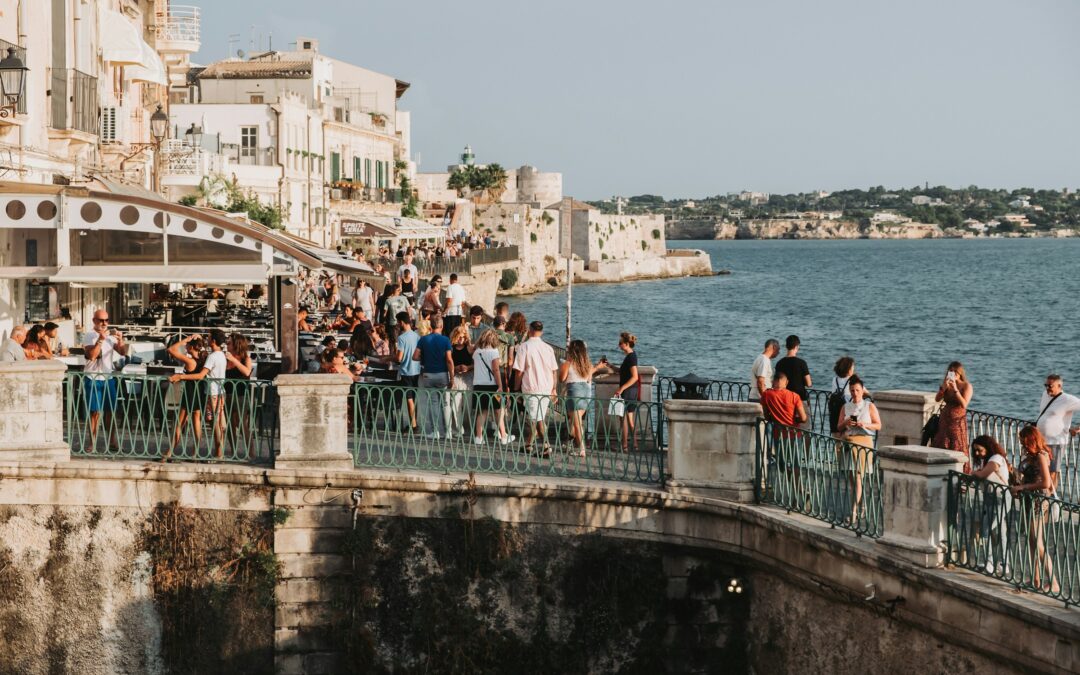
Ortigia Sicily in summer is magnificent but busy. The piazza fills with visitors every evening. Restaurants need advance booking. The heat in July and August makes afternoon sightseeing genuinely tiring. Nevertheless, the atmosphere is vibrant, the evening passeggiata along the waterfront is extraordinary, and the sea is warm enough for hours of swimming from the rocks along the eastern coast.
Winter
Quiet, atmospheric and genuinely beautiful. The winter light on the baroque architecture is softer and more dimensional than at any other time of year. Prices drop significantly. Moreover, you will often find the cathedral square almost entirely to yourself a rare and remarkable experience.
Ortigia Sicily and the Val di Noto: the wider region
Ortigia Sicily sits at the gateway to one of the most remarkable cultural landscapes in the Mediterranean Val di Noto. This UNESCO World Heritage region of baroque towns rebuilt after the devastating earthquake of 1693. Within an hour’s drive, the region reveals itself in extraordinary fashion.
Noto is widely the finest baroque town in Sicily. Its main street is a continuous parade of golden stone facades that glow in the afternoon light. Meanwhile, Ragusa Ibla descends dramatically into a valley, its baroque churches and aristocratic palaces tumbling down hillsides above olive groves and citrus orchards. Modica is famous for its extraordinary chocolate. The Spanish introduced the recipe in the sixteenth century. It is cold-processed, granular, intensely flavoured and unlike any other chocolate in the world. For the full story of this region, read our guide to Sicily’s baroque towns of the southeast coast.
Day trips from Ortigia Sicily
Ortigia Sicily makes an excellent base for day trips. Several extraordinary destinations are within easy reach.
The Neapolis Archaeological Park (just across the bridge on the mainland) contains a Greek theatre, a Roman amphitheatre and the mysterious Ear of Dionysius limestone cave. Furthermore, the Greek theatre hosts performances of classical drama every summer. This programme has run since 1914 one of the most extraordinary cultural experiences in Sicily.
Thirty kilometres south, the Vendicari Nature Reserve is home to flamingos, herons, ancient tuna fisheries and some of the most beautiful beaches in southeastern Sicily. In addition, during spring and autumn, bird migration makes it one of the finest wildlife destinations in the Mediterranean.
How Time for Sicily can help you plan your Ortigia visit
Ortigia Sicily rewards local knowledge more than almost anywhere else on the island. Which osteria in the Arab quarter has cooked the same pasta al nero di seppia for forty years? And which baroque palace is now the finest small hotel on the island? The right answer to these questions makes the difference between a good trip and an extraordinary one.
Not sure where to begin? Book a free call with our team for a local advice from people who know this island deeply.
Final thoughts
Ortigia Sicily is very difficult to describe to someone who has not been there. It is completely impossible to forget once you have.
It is too small to get lost in, yet somehow inexhaustible. Too ancient to feel modern, yet too alive to feel like a museum. On the other hand, it is exactly the kind of place where an afternoon walk turns into an evening. And an evening turns into a decision to stay another day.
Come with an open itinerary. Walk slowly. Eat well. Sit in the piazza as the light changes on the cathedral facade.
You will understand immediately why people keep coming back to Ortigia Sicily.
Photo: Unsplash