

On Tuesday, January 20, 2026, Cyclone Harry struck Eastern Sicily, from Messina to the province of Siracusa, passing through Catania. What followed was not chaos or complaint, but one of the most powerful grassroots volunteer movements the island has seen in recent years — a story of resilience, solidarity, and people who chose action over despair. This short article covers the story with the words of Founder of Time for Sicily.
What happened in Sicily with Cyclone Harry
On Tuesday, January 20, 2026, Cyclone Harry hit Sicily, bringing intense rainfall, flooding, and widespread damage along the Eastern coast of the island.
It arrived with violence and speed, affecting large parts of the Eastern coast of the island, from Messina down to the province of Siracusa. While flooding and wind caused widespread disruption, most of the damage was inflicted by huge sea waves that hit coastal villages with exceptional force, reshaping beaches, damaging ports and seaside businesses, and invading private homes along the shoreline.
There are moments when a land you love is not something you simply promote, narrate, or sell — it becomes something you must serve. What struck me most in the hours and days following Cyclone Harry was not the destruction itself. Sicily has known destruction before, many times. What struck me was the reaction of its people.
There was no widespread victimhood, no collective complaining, and no resignation. Instead, there was action. People rolled up their sleeves and got to work. They cleaned streets, helped neighbors, removed debris, and restored what could be restored, often without waiting for instructions or institutional coordination.
A different kind of response
In the immediate aftermath of the cyclone, something extraordinary unfolded across Eastern Sicily. Ordinary citizens — families, young people, surfers, shop owners, students, workers — came together with a shared sense of responsibility. Buckets, shovels, gloves, and pure human energy became the first tools of recovery.
This was not the postcard Sicily often shown to the world, nor the romanticized version frequently used in travel brochures. This was the real Sicily: resilient, pragmatic, proud, and deeply communal.
The volunteer movement that changed everything
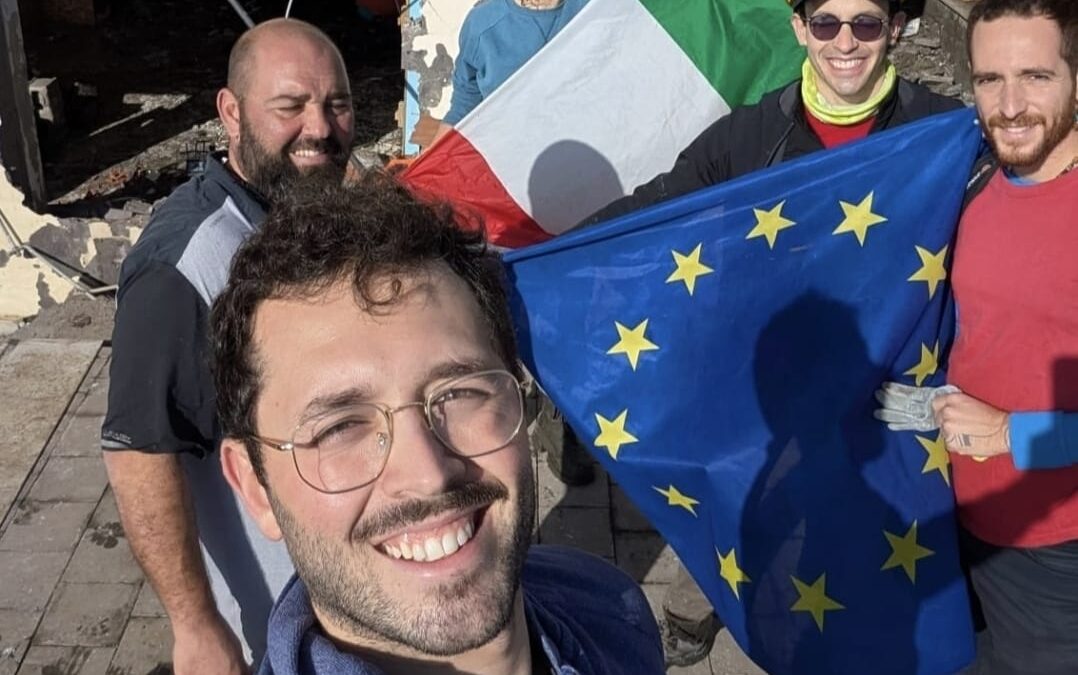
At the heart of this response, a powerful grassroots movement rapidly took shape. Led by Simone Grasso and Simone Dei Pieri of the Associazione Cambia, and supported on the ground by the volunteers of Plastic Free, an impressive volunteer network was organized in a matter of days.
As of today, more than 1’000 volunteers have been mobilized across seven or more active locations along the Eastern coast of Sicily, covering a vast area from Messina to the province of Siracusa, with particular focus on the hardest-hit coastal villages. Volunteers coordinated clean-up operations, logistics, and on-the-ground support with remarkable efficiency and humility.
There was no search for visibility, no personal branding, and no ego. There was only service, presence, and a shared determination to help the land and the people who live on it. The strength and scale of this spontaneous civic response were so significant that it deserved — and received — national recognition. The movement and its volunteers were the subject of an article by Corriere della Sera, one of Italy’s leading newspapers and a key voice for Sicily. It was a rare and deserved acknowledgment of a community that chose action over lament.
A land that has always known how to rise again
To understand this reaction, one must look at the deeper history of Eastern Sicily. This is a land that has always lived with the power of nature. Earthquakes, volcanic eruptions, tsunamis, and floods are not abstract concepts here; they are part of collective memory.
From the devastating earthquake of 1693 that reshaped entire cities, to the recurrent eruptions of Mount Etna, to repeated floods over the centuries, Eastern Sicily has been tested again and again. Each time, reconstruction did not begin with systems or institutions, but with people. Families, neighbors, and communities have always been the true engine of recovery.
There is an unspoken historical understanding in this land: survival is collective. Cyclone Harry did not create this instinct; it simply reactivated something ancient and deeply rooted.
Why I went there personally to help in the Cyclone Harry Sicily aftermath
I did not go as a founder, an entrepreneur, or the face of a brand. I went as a Sicilian. As someone who built Time for Sicily to tell the story of this land, I believe that storytelling without responsibility is empty.
I rolled up my sleeves and joined the clean-up efforts in two different locations. At the Surf School School, on Playa Beach, we helped Antonio remove debris, mud, damaged materials, and water left behind by the cyclone. In Aci Trezza, we worked alongside volunteers and local residents to help private families clean their homes and properties.
There were no cameras, no content creation, and no visibility strategy. There was only work. Because Sicily is not something you consume. Sicily is something you belong to.
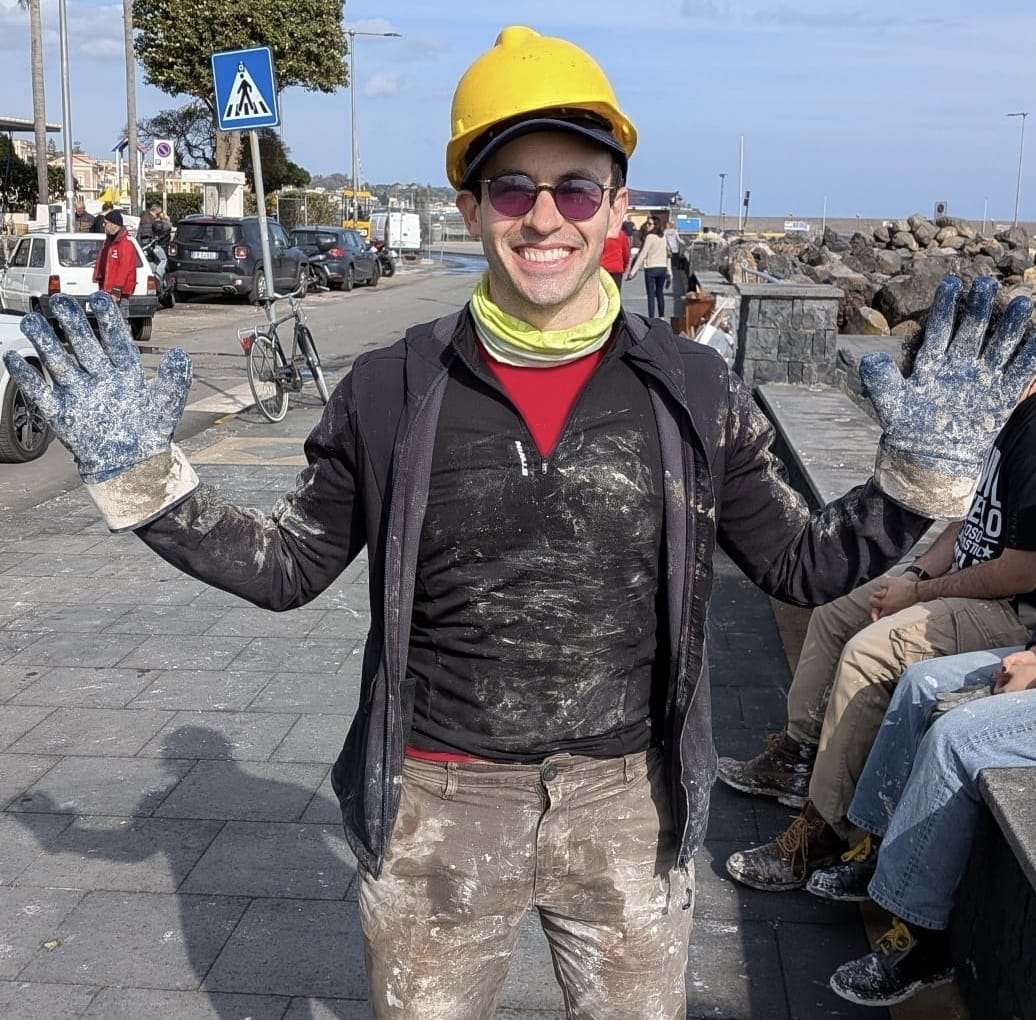
Cyclone Harry Sicily clean up with Time for Sicily Founder Francesco Messina after the heavy and dirty job
Giving back to Sicily is not a campaign
Time for Sicily exists to create meaningful travel experiences and deep connections with this land. But connection cannot be one-directional. You cannot only take from a place; you must also give back to it, especially when it is vulnerable.
Showing up when it is difficult, standing with local communities, and contributing through action are not marketing choices. They are duties. This is not charity, branding, or positioning. It is identity.
Sicily is not fragile. Sicily is resilient.
Cyclone Harry did not reveal the weakness of Sicily. It revealed its strength. That strength was visible in the faces of volunteers, in hands covered in mud, in silent work carried out without applause, and in the collective refusal to surrender to despair.
Sicily is a land that falls and rises, again and again. And as long as there are people like the volunteers of Associazione Cambia, like Simone Grasso, like Simone Dei Pieri, and like the hundreds of anonymous Sicilians who showed up without hesitation, Sicily will always rise.
This is not a story about a cyclone. It is a story about a people, and about a land that teaches the true meaning of resilience.
— Francesco Messina, Founder of Time for Sicily – www.timeforsicily.com
Learn more about us, who whe are and what we do.
———————————————————————————————————
Photo Credits: @Simone Grasso